leave a message
If you are interested in our products and want to know more details,please leave a message here,we will reply you as soon as we can.
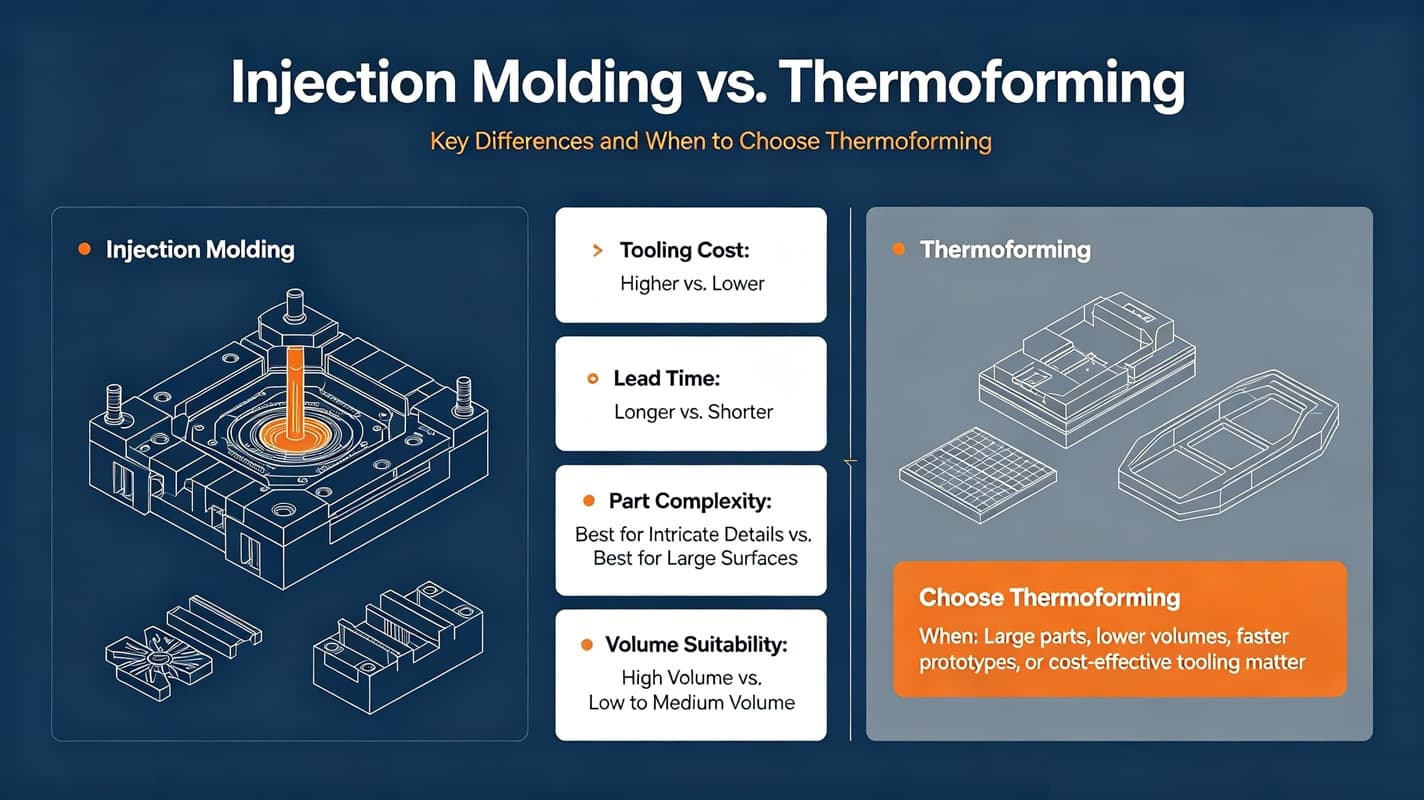
When designing custom plastic components, choosing the right manufacturing process is just as critical as selecting the right raw material. Two of the most prominent manufacturing methods in the plastics industry are Injection Molding and Thermoforming (Vacuum Forming).
While both techniques transform raw plastic into functional, high-quality products, they operate on entirely different principles, economic models, and design parameters.
To help product designers, engineers, and procurement managers make the best decision for their upcoming projects, this guide breaks down the core differences between injection molding and thermoforming, and highlights the specific scenarios where thermoforming is the superior choice.
While injection molding often steals the spotlight for mass-produced consumer goods, heavy-gauge thermoforming is frequently the smarter, more economical choice in the following situations:
If your project involves large components—such as medical equipment enclosures, automotive body panels, refrigerator liners, or heavy machinery cowlings—injection molding would require massive, prohibitively expensive presses and tooling. Thermoforming easily accommodates large dimensions at a fraction of the tooling cost.
For niche industrial equipment, specialized vehicles, or custom displays where production runs range from a few dozen to a few thousand units per year, the high upfront investment of injection molding is hard to justify. Thermoforming tooling costs significantly less, making low-volume production financially viable.
When you are launching a new product and need market validation quickly, waiting 2–3 months for steel injection molds can cause costly delays. Thermoforming tools can often be designed, machined, and sampled in a matter of weeks, allowing you to get your product to market faster.
Thermoforming utilizes pre-extruded sheets, allowing you to easily leverage advanced engineering materials with specialized properties—such as ABS capped with ASA for ultimate outdoor UV resistance, or fire-retardant PC/ABS alloys—without altering complex injection parameters.
Product designs often evolve during early lifecycle phases. Modifying a thermoforming mold is typically faster and much less expensive than altering a steel injection mold, providing greater flexibility for engineering changes.
Neither injection molding nor thermoforming is universally "better"—rather, the right choice depends entirely on your part size, production volume, budget, and timeline.
At Radiant Honor Co., Ltd, we specialize in helping our clients navigate these manufacturing choices. Whether you need heavy-gauge thermoformed enclosures or high-precision injection-molded components, our engineering team provides expert DFM (Design for Manufacturing) analysis to ensure your project succeeds.
Contact our engineering team today to discuss your project requirements and receive a free quote and DFM evaluation!
Scan to Wechat :

Scan to WhatsApp :