Heavy-Gauge Thermoforming vs. FRP (Fiberglass Reinforced Plastic): Cost, Speed, and Quality
When engineering large plastic enclosures, machinery cowlings, medical equipment housings, or automotive body panels, product designers often reach a crossroads when choosing a manufacturing process. Two of the most prominent contenders for medium-to-large custom parts are Heavy-Gauge Thermoforming (Vacuum/Pressure Forming) and FRP (Fiberglass Reinforced Plastic, also known as GRP).
While both methods are capable of producing robust, oversized components without the prohibitive tooling costs of injection molding, they operate on entirely different principles. This guide compares thermoforming and FRP across three critical pillars: Cost, Speed, and Quality, to help you make the best strategic choice for your next project.
1. Overview of the Technologies
Heavy-Gauge Thermoforming: A manufacturing process where a thick extruded plastic sheet is heated to a formable state, draped over a single-sided mold (aluminum or composite), and shaped using a vacuum and/or positive air pressure.
FRP (Fiberglass Reinforced Plastic): A composite material made of a polymer matrix reinforced with glass fibers. It is typically manufactured using open-mold hand lay-up, spray-up, or closed-mold Resin Transfer Molding (RTM), followed by manual trimming and painting.
2. Cost Comparison: Tooling and Unit Economics
Cost is frequently the deciding factor between these two processes, but the math depends heavily on your production volume.
- Thermoforming requires a machined aluminum or cast metal mold. While upfront tooling investment is required, aluminum molds are highly durable and can last for tens of thousands of cycles.
- FRP often utilizes low-cost composite or fiberglass tooling for low volumes, making initial tooling entry very cheap. However, these soft molds wear out quickly in high-volume runs.
- Thermoforming is a highly automated, repeatable process. Once the machine is dialed in, cycle times are fast, and labor costs per part are relatively low.
- FRP manufacturing is notoriously labor-intensive, relying heavily on manual skill for hand lay-up, rolling out bubbles, trimming, and sanding. Consequently, labor costs drive up the per-piece price, especially as wages rise.
3. Speed Comparison: Prototyping and Production Lead Times
In modern manufacturing, time-to-market can make or break a product launch.
- Thermoforming aluminum tooling can typically be designed, CNC-machined, and textured within 2 to 4 weeks.
- FRP molds can sometimes be made even faster using quick-cure resins, but building durable production-grade composite molds still takes comparable time.
- Cycle Times & Production Speed:
- Thermoforming wins hands down in production speed. A single thermoforming cycle takes anywhere from a few minutes to under a minute depending on part size.
- FRP is constrained by chemical curing times. Resins must cure (often requiring heat lamps or room-temperature setting), making cycle times much slower (hours rather than minutes).
4. Quality & Performance: Aesthetics and Material Properties
How do the finished parts look and perform in the field?
- Surface Finish & Aesthetics:
- Thermoforming uses pre-finished, extruded plastic sheets. You can choose from a vast array of built-in textures, UV-resistant caps (like ASA), and high-gloss or matte colors straight from the sheet, eliminating the need for painting.
- FRP parts straight out of the mold often require extensive secondary finishing—including trimming, body-filling, sanding, priming, and painting—to achieve a Class-A cosmetic surface.
- Weight and Strength-to-Weight Ratio:
- FRP offers exceptional structural rigidity and strength, making it a favorite for heavy-duty structural parts exposed to extreme stress.
- Thermoforming utilizes engineered thermoplastics that offer excellent impact resistance, chemical resistance, and a lighter overall weight for mid-sized housings.
5. Summary Matrix: Thermoforming vs. FRP
| Feature |
Heavy-Gauge Thermoforming |
FRP (Fiberglass Reinforced Plastic) |
| Best Production Volume |
Low to Medium-High (100 – 10,000+ units) |
Prototypes to Low-Medium (1 – 1,000 units) |
| Tooling Investment |
Moderate (Machined Aluminum Molds) |
Low to Moderate (Composite/Resin Molds) |
| Production Speed / Cycle Time |
Fast (Minutes per part) |
Slow (Hours per part due to curing) |
| Labor Dependency |
Low (Automated machine processing) |
High (Manual lay-up and finishing) |
| Secondary Finishing |
Minimal (Automated CNC trimming) |
High (Trimming, sanding, painting required) |
| Ideal Applications |
Medical housings, kiosk shells, vehicle interior panels |
Large boat hulls, wind turbine blades, heavy-duty industrial tanks |
6. Partner with Radiant Honor Co., Ltd
Choosing between heavy-gauge thermoforming and FRP depends on your specific volume, budget, structural requirements, and aesthetic goals. If your project demands clean aesthetics, fast cycle times, and cost-efficiency in medium-to-high volumes, heavy-gauge thermoforming is almost always the superior choice.
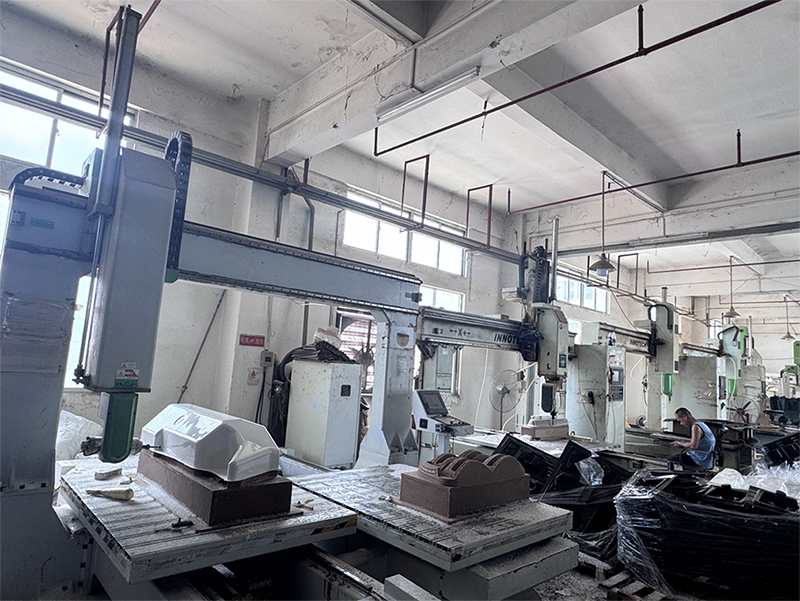
At Radiant Honor Co., Ltd, we specialize in precision heavy-gauge thermoforming and secondary CNC machining. Whether you are transitioning an existing FRP design into a more scalable thermoformed product, or developing a brand-new custom plastic housing, our engineering team is here to assist.
Contact Radiant Honor today to speak with our technical experts and request a comprehensive project evaluation and quote!